
Jeff Davis Release Date Types
A projected date is an estimate or scheduled point based on facts known now. An actual release date records when custody ended or changed. Those dates can match, but they need not. A bond order, transfer, detainer, disciplinary event, sentence correction, or parole decision can alter the result before the person reaches the exit.
Four terms matter in Jeff Davis County release-date research. A county jail sentence date is calculated from the court sentence, credit for time served, and any earned-time allowance. The Georgia Department of Corrections defines Maximum Release Date, or MRD, as the date the sentence imposed by the judge is fully served, also called max-out. The Georgia State Board of Pardons and Paroles uses Tentative Parole Month, or TPM, for a possible future parole review. Actual release is the event that must be confirmed after it occurs.
- MRD
- The state sentence maximum, when the judicial sentence will be completely served.
- TPM
- The month for final parole review, not a final decision or confirmed exit date.
- Discharge
- The end of a sentence or supervision obligation, which differs from release to parole.
- Detainer
- A request or hold from another authority that may prevent release to the community.
Find a Jeff Davis Release Date
Start with the custody type. The Jeff Davis County Detention Center handles local jail custody, while GDC records cover state offenders. The court sentence is central for a county term. State records add MRD, parole, and program-credit concepts. A generic name search can mix these systems and produce the wrong date.
- Confirm whether the person is at the county detention center, in GDC custody, awaiting court action, or already on parole.
- For local custody, call the detention center at (912) 375-6604 and ask whether the person is pretrial or serving a county sentence.
- Check the sentencing order or case disposition through the court. Ask about credit for time served and any later order that changes the sentence.
- For state custody, use the GDC offender search by name, ID, description, or case number and identify the date term shown.
- If parole is under review, use the Board TPM lookup. Treat a TPM as review timing only.
- After the anticipated date, confirm the actual event with the jail, GDC, parole records, or the court rather than relying on an old projection.
GDC expressly advises users to verify its online information with Inmate Records and Information before drawing conclusions. Written correspondence may be sent to P.O. Box 1529, Forsyth, GA 31029. The online result is useful for finding the right record, but it is not a certified release document.
Georgia Dates in Jeff Davis Records
A Jeff Davis County arrest does not make every person a GDC offender. Someone who bonds out on a local charge may never appear in the state tool. GDC becomes relevant when a person enters state custody or has a state corrections history. The Parole Board tools then answer a narrower set of parole questions.
| Official channel | Date or field | What it means | Limit |
|---|---|---|---|
| GDC offender search | Sentence and status details | A state custody and release-date lead | Not a Jeff Davis County jail release list |
| GDC terminology | MRD or max-out | The date the imposed sentence is fully served | Not the same as parole |
| Board TPM lookup | Tentative Parole Month | Timing for final parole review | Does not guarantee release |
| Parolee database | Post-release parole status | Evidence of current parole supervision | A discharged person may no longer appear |
The Board may establish a TPM or deny parole, and it can reconsider a decision before release. Final review decides whether a release date is set. For a person already out on parole, the parolee database is more useful than the TPM lookup. The DCS Hazlehurst Field Office supplies local supervision context for Jeff Davis County after release.
The two Board searches also require different identifying facts. The TPM lookup uses a six-digit inmate number, GDC ID, and personal data to locate a person who is still under parole consideration. The parolee database accepts first and last names, including partial terms, to find a person after release to parole. Neither tool replaces the sentencing order. A TPM can depend on good conduct, treatment, or program completion, and the Board may change it before the person leaves prison.
Note: A future date shown in a state system does not prove that the person has left either county or state custody.
Jeff Davis County Earned Time
County jail release-date computation has its own Georgia rule. Under O.C.G.A. 42-4-7, a county inmate serving a sentence is released when the term expires, less allowed earned-time deductions. The general earned-time allowance cannot exceed one-half of the imposed confinement. The sheriff or custodian may authorize up to four days of credit for each day on an approved work detail, subject to the statute's terms and limits.
This does not create one public formula that an outside reader can apply with certainty. The starting sentence, credit for time already served, the custodian's earned-time calculation, work-detail records, and jail discipline all matter. A court may also correct or alter a sentence. The reliable Jeff Davis County release date therefore comes from the judgment plus the detention center's current computation, not from subtracting a rough percentage from a sentence.
Pretrial custody is different. A detainee who has not been sentenced has no earned-time sentence date to calculate. Release may follow bond, dismissal, a court order, transfer, or later disposition. The Jeff Davis County Clerk of Superior Court manages Superior, State, and Juvenile court records, while the Magistrate Court handles its own criminal matters and bond inquiries.
For the underlying judgment, the Jeff Davis County court path depends on the case. The local Magistrate Court guidance directs misdemeanor dispositions to the State Court clerk and felony dispositions to the Superior Court clerk. The clerk's public listing gives office hours of 8:00 a.m. to 5:00 p.m. on weekdays at 14 Jeff Davis Street in Hazlehurst, with phone (912) 375-6615. A disposition can confirm the sentence or case outcome behind a jail calculation, but detention staff remain the source for the current earned-time computation.
Jeff Davis State Release Credits
GDC Performance Incentive Credit, known as PIC, is a state corrections program and should not be confused with county earned time. The GDC PIC program permits eligible offenders to earn up to twelve points. Those points can potentially move a TPM or MRD by one to twelve months through case-plan work, education or vocational progress, and detail or work assignments.
The Parole Board explains that when parole is tentatively scheduled, it may set both a TPM and a PIC date. The span between them is the most that qualifying progress can advance the TPM. Poor conduct can delay parole timing or contribute to denial. Program completion alone does not guarantee release because eligibility, conduct, Board discretion, detainers, and offense rules remain part of the decision.
The successful manifest image for this subject comes from the official GDC Performance Incentive Credit page.
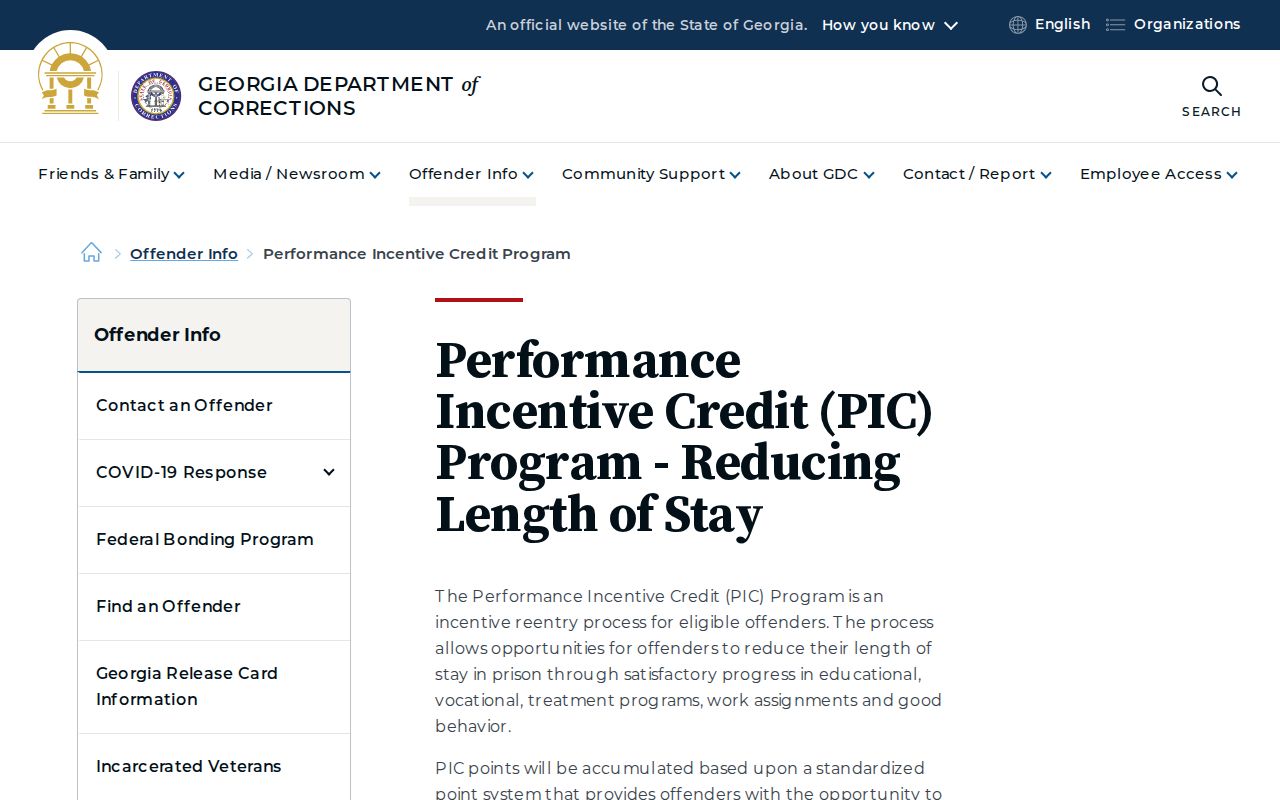
The captured page helps separate state PIC rules from the county jail earned-time calculation.
Jeff Davis Release Eligibility Limits
Georgia does not apply one universal 85 percent rule to every Jeff Davis County sentence in the sources reviewed. Release timing depends on the offense, sentence, mandatory minimum, parole eligibility law, recidivist rules, and Board action. A blanket percentage can therefore give a false date.
O.C.G.A. 42-9-45 supplies general parole-eligibility periods and exceptions. It states that misdemeanor-sentence inmates are generally eligible after six months or one-third of the sentence, whichever is greater. Most felony-sentence inmates are generally eligible after nine months or one-third, whichever is greater. A term or combined terms of at least 21 years generally has a seven-year point, subject throughout to exceptions and other laws.
Listed serious violent felonies fall under O.C.G.A. 17-10-6.1, which includes mandatory-minimum limits. The exact conviction and sentencing order must be checked before applying ordinary parole timing. Eligibility means a case can be considered. It does not mean parole will be granted on that day.
Parole timing can also be affected by a detainer and the person's release plan. The Board's eligibility guidance treats those facts as part of parole consideration. Even when a tentative date exists, another authority may hold the person or receive custody. The resulting GDC exit can therefore be a transfer rather than a return to Jeff Davis County. Check the receiving agency before describing that date as community release.
Why Jeff Davis Dates Change
A date moves when the legal or custody facts behind it change. County and state systems do not update for the same reasons or on the same schedule. The source of the date must stay attached to the date itself.
| Factor | Possible effect | Best confirmation source |
|---|---|---|
| Earned time or work detail | May reduce a county sentence calculation | Detention center and sentencing record |
| PIC progress | May advance an eligible state TPM or MRD | GDC and Parole Board |
| Discipline or poor conduct | May reduce credit or delay parole timing | Custody agency or Board |
| Detainer or transfer | May prevent community release | Releasing agency and receiving agency |
| New court order | May change sentence, credit, bond, or custody | Jeff Davis County court file |
| Parole final review | May set, delay, change, or deny release | Georgia Parole Board |
A county record may say transfer even though a person no longer appears at the detention center. That is not the same as release to the community. GDC, another county, federal custody, or ICE may become the next place to verify.
Confirm Jeff Davis Actual Release
Near the projected day, check the same agency that owns the record. For a county term, contact the Jeff Davis County Detention Center and compare the answer with the court judgment. For state custody, review GDC status and the Board's parole information. A formal GDC request is available through the GDC open-records portal; GDC states that it provides an initial response within three business days, while copying, search, and redaction charges may apply.
Georgia VINE can send custody-change alerts when the relevant agency participates, but it is not a permanent release archive. The focused VINELink Release Check explains notification registration. If a written county record is needed, the sheriff's form can request the booking and release entry, including release time, reason, transfer note, and related case number.
Final proof comes after the event. Confirm whether the person left custody, entered parole, transferred, or reached full discharge. Each outcome answers “when were they released” in a different way.
Public Record Search
Sponsored Results